
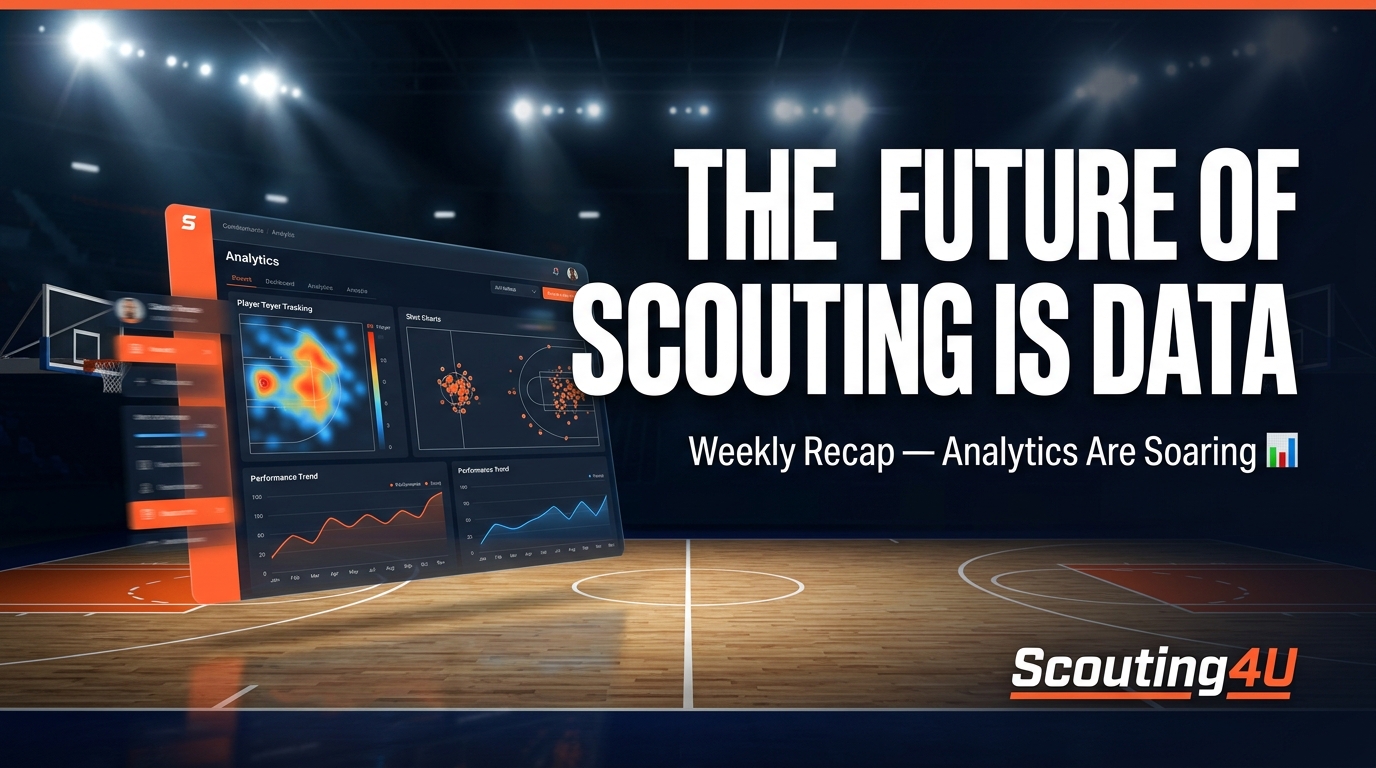
The Future of Basketball Scouting: Analytics Soaring
The Future of Basketball Scouting: Analytics Soaring
The future of basketball scouting is changing how teams operate at every level. Basketball analytics is no longer a niche concern for data-obsessed front offices. It is now a competitive necessity. The market is projected to reach $6 billion by 2033, growing at roughly 27% year over year. AI-driven tools are at the center of this shift, compressing scout report prep time from six hours to under two minutes. This article pulls together the most important developments in that story - and shows you what to do next. It gives coaches, scouts, and front office staff a clear picture of where the industry is heading and what tools are worth their attention.
Why the Future of Basketball Scouting Matters Now
Scouting used to be a slow process. A scout watched film, took notes, built a report manually, and handed it off days later. By then, the opponent had already adjusted. That model is broken, and the replacement is already here.
AI systems can now generate detailed player tendency reports in real time. They pull from game logs, track shot selection under pressure, flag defensive rotations, and surface patterns a human analyst might miss after hours of film study.
Teams that adopt analytics early tend to find an edge before their competitors catch up. That window closes fast. The real question is which tools are worth investing in and which ones are still too raw for game-day use.
Speed is not the only factor. Depth matters too. The useful questions are about the real-world decisions scouts and coaches are making right now - not theoretical projections about what analytics might someday do. This article is built around that principle: what is actually in use, what is working, and what still needs time.
AI's Role in Modern Basketball Scouting
AI basketball scouting tools are no longer experimental. They are in active use at the professional and semi-professional level across multiple continents. Scouting4U's AI scout report generator is one of the clearest examples. It produces a full player evaluation in roughly two minutes, pulling live data and formatting it for immediate use.
The difference between a manually produced report and an AI-generated one is not just speed. It is consistency. Human analysts get tired. They miss things late in a film session. AI does not. Every report follows the same evaluation framework, which makes it easier to compare players across leagues and positions.
If you want to see exactly how this works in practice, the post Watch AI Write a Scout Report in Real-Time walks through the process step by step. It is one of the clearest demonstrations of what this technology can actually do when it is pointed at a real player.
The trajectory is clear. AI-assisted scouting is not replacing human judgment - it is freeing scouts to apply that judgment where it counts most, rather than spending six hours on a report that AI can draft in minutes.
There is also a reliability argument worth making here. A scout working on their fourth report of the day is not operating at full capacity. An AI system running its hundredth report of the day performs exactly the same as it did on the first. For organizations processing large volumes of pre-game analysis, that consistency is worth more than most people initially expect. It is one of the practical advantages that gets underestimated until you actually use these tools in a real workflow.
European Basketball and the Analytics Gap
European basketball presents a specific challenge for traditional scouting. The style of play differs from North American basketball in meaningful ways. Ball movement is faster. Spacing looks different. Post play has a larger role in many systems. Scouts trained on NBA or college tape sometimes misread European players as a result.
AI analysis helps close that gap. When a system is trained on EuroLeague and Liga ACB data, it evaluates players against the right baseline. A 40% three-point shooter in the EuroLeague is not the same as a 40% shooter in the G League, and a good AI model accounts for that context.
For a detailed look at how European and American basketball compare stylistically, read Is European Basketball Better Than American? A Deep Dive. It gives scouts a solid foundation for understanding why cross-league evaluation requires more than a box score.
European league developments deserve close attention because the best international prospects are often undervalued until someone with the right tools looks closely enough. That is an opportunity for organizations willing to invest in the right scouting infrastructure.
European leagues also run on different calendars than the NBA. That means scouting windows open and close at different times. Organizations that rely on a single-market analytics platform miss players at exactly the moment those players are performing. Tracking these scheduling patterns alongside the analytics tells you when to act, not just what to look for.
The Basketball Analytics Market: Where the Money Is Going
The $6 billion projection for 2033 is not a guess. It is based on current adoption rates, investment flows into sports tech, and the documented return on analytics investment at the team level. Knowing where the money is going tells you where the tools are headed.
Right now, most of the growth is concentrated in three areas: player evaluation software, in-game decision support tools, and recruitment platforms. Each of these has a direct impact on how scouting departments operate. For a deeper breakdown of the market numbers, the post on the basketball analytics market's $6B future by 2033 is worth reading in full.
What matters for scouts and coaches is not the headline number. It is the practical implication: more organizations are buying these tools, which means the competitive gap between teams using analytics and teams relying on traditional methods is widening every season.
Staying on the right side of that gap means turning the most relevant market updates into decisions you can act on immediately.
One pattern that keeps showing up in the market data is that mid-tier professional leagues are now investing in analytics at a rate that used to be limited to top-flight competition. That matters for scouting because it changes the information environment. When more organizations have access to similar data tools, the edge goes to whoever interprets and applies that data better. It pays to notice these adoption shifts as they happen, not after they have already changed the competitive picture.
Player Tendency Analysis: The Detail That Changes Games
One of the most underused applications of basketball analytics is tendency analysis. Most scouts know a player's scoring average. Fewer know how that player's shot selection changes in the fourth quarter, or how they handle ball screens on the weak side, or what their turnover rate looks like when they are guarded by a physical defender.
Tendency analysis answers those questions with precision. It tells a coach not just what a player does, but when and why they do it. That information changes defensive game plans in ways that box scores never could.
Tendency analysis is where AI has made the biggest practical difference. Automated systems can build a tendency profile from hundreds of possessions in the time it would take a human analyst to review twenty clips.
For a detailed breakdown of how to build these profiles and use them in real scouting situations, the article on Basketball Player Tendency Analysis Scouting: A Secret Weapon is an excellent resource. It goes deeper than most publicly available material on the subject.
Game-specific tendency data is also where coaching staffs gain an edge in late-game situations. Knowing that a particular ball handler becomes turnover-prone when forced left after the eight-minute mark in the fourth quarter is not trivia. It is the kind of information that shapes a team's entire closing defensive scheme. Use cases like this show how analytics moves from spreadsheet to game plan in real organizations. You can also explore Basketball Tendency Analysis: Decoding Opponent Patterns for more on how to apply this in practice.
Scouting Undervalued Players: Where AI Has a Real Advantage
Finding undervalued players is the oldest competitive advantage in professional sports. The problem is that traditional scouting is expensive and slow. You can only send so many scouts to so many games. Markets with less media coverage get less attention, and players in those markets stay undervalued longer than they should.
AI changes the math. A well-built scouting platform can process data from dozens of leagues simultaneously. It flags players whose underlying numbers outperform their reputation. It identifies prospects before they appear on traditional radar. That is a real edge for organizations willing to act on it.
If roster construction is a priority for your organization, start with Data-Driven Basketball Recruitment: A Front Office Guide. It covers the process from identifying targets to making the final evaluation, with a clear focus on how data fits into each step. For another angle on finding hidden talent, Scouting Undervalued Basketball Players: Hidden Gems is worth bookmarking too.
There is a budget argument here as well. Hiring more scouts to cover more leagues costs money that most organizations outside the top tier do not have. An AI platform that covers forty leagues costs a fraction of that. The economics are becoming impossible to ignore for front offices at every level.
What to Look for in a Scouting Platform
Not every analytics tool is worth the subscription cost. A few checks separate genuinely useful tools from products that look impressive in a demo but fall apart under real working conditions.
Speed matters. A report that takes forty-five minutes to generate is not solving the original problem. Cross-league data coverage matters too. A platform that covers the NBA but ignores European leagues has a significant blind spot for international recruitment. Integration with video also makes a difference - numbers without footage context are harder to act on.
Scouting4U covers all three. The platform generates AI scout reports in real time, draws on data from multiple leagues, and connects statistical analysis to video. For a full breakdown of the tools available, visit the Scouting4U platform features and tools page. It covers everything in detail, including features built specifically for different user types - coaches, scouts, and front office analysts.
If you are evaluating subscription options, the Scouting4U subscription plans and pricing page lays out what is included at each tier.
One thing worth checking before committing to any platform is how the data is sourced and how often it updates. Stale data is worse than no data in some situations. A platform showing last week's numbers as current can send a coaching staff in the wrong direction before a game. Ask vendors directly about their update cadence and data sourcing process - it is an easy question to forget during a sales demo.
Conclusion: Stay Current with the Future of Basketball Scouting
The future of basketball scouting is already here, and it rewards anyone who stays current in a field that is moving fast. The analytics market is growing. AI scouting tools are improving. The organizations that adapt quickly are gaining ground on those that do not.
The developments that actually matter are practical ones: faster reports, wider league coverage, tendency analysis, and statistics connected to video. Keep an eye on them, and you will never be the last one in your league to know what is changing.
To see what this looks like with your own league's data, book a demo with our team. The gap between analytics-driven organizations and traditional ones is measurable - and it is growing every season. The right tools put you on the right side of it.
Frequently Asked Questions
What is the future of basketball scouting?
The future of basketball scouting is data-led. AI tools draft scout reports in minutes, tendency analysis shows what a player does and when, and statistics connected to video make the numbers easier to act on. Scouts still make the final call - the tools give them more time to make it well.
How does AI actually reduce scout report prep time?
AI systems pull player data automatically from game logs and statistical databases, apply a consistent evaluation framework, and generate a formatted report without manual input. What previously required a scout to watch several hours of film and write up findings now takes roughly two minutes. The report quality stays consistent regardless of how many are generated in a single session, which matters when you are preparing for multiple opponents in a short window.
Is AI scouting useful for smaller organizations without big budgets?
Yes. One of the practical advantages of AI scouting tools is that they let smaller organizations compete with larger ones on information quality. A team that cannot afford multiple full-time scouts can still access detailed player analysis across multiple leagues if they use the right platform. That matters because budget is a real constraint for most organizations outside the top tier of professional basketball.
How do I evaluate whether a basketball analytics platform is worth the cost?
Look at report generation speed, league coverage, and whether it connects statistics to video. A platform that scores well on all three is worth serious consideration. Ask for a live demo with real player data from a league you actually scout - that will tell you more than any feature list. Also ask how frequently the data updates, since outdated numbers can send coaching decisions in the wrong direction before a game.
Where can I learn more about Scouting4U's tools and approach?
The About Scouting4U page covers the company's background, the team behind the platform, and how the product has developed. For a hands-on look at the tools themselves, the platform features page goes into detail on each component. If you want to see a demo or ask specific questions, the contact page is the fastest way to reach the team directly.
Enjoyed this article? Share it with others!
Founder & Lead Scout, Scouting4U
2x EuroLeague champion with 30+ years in professional basketball. Daniel won EuroLeague titles with Maccabi Tel Aviv, helped build the staff behind the 2007 European Championship, and has delivered 100+ professional scouting reports across 50+ leagues. If it happened in a European basketball front office, he was probably in the room. He founded Scouting4U in 2010 to bring championship-level scouting intelligence to every club.
No reviews yet. Be the first to share your experience!
Related Articles
Future of Basketball Scout Reports: AI & Innovation
Key Takeaways Basketball scout reports are changing fast because of AI. Data collection and analysis now happen in a fr...
AI Scouting Reports in Basketball: The Scouting Edge
Key Takeaways AI scouting reports basketball tools give coaches faster, clearer data on players. Scouting4U pairs AI an...
Analyzing Basketball Player Potential: Scouting Insights
Key Takeaways Analyzing basketball player potential combines data analysis with scouting intuition. Core metrics includ...